Resources
Blog

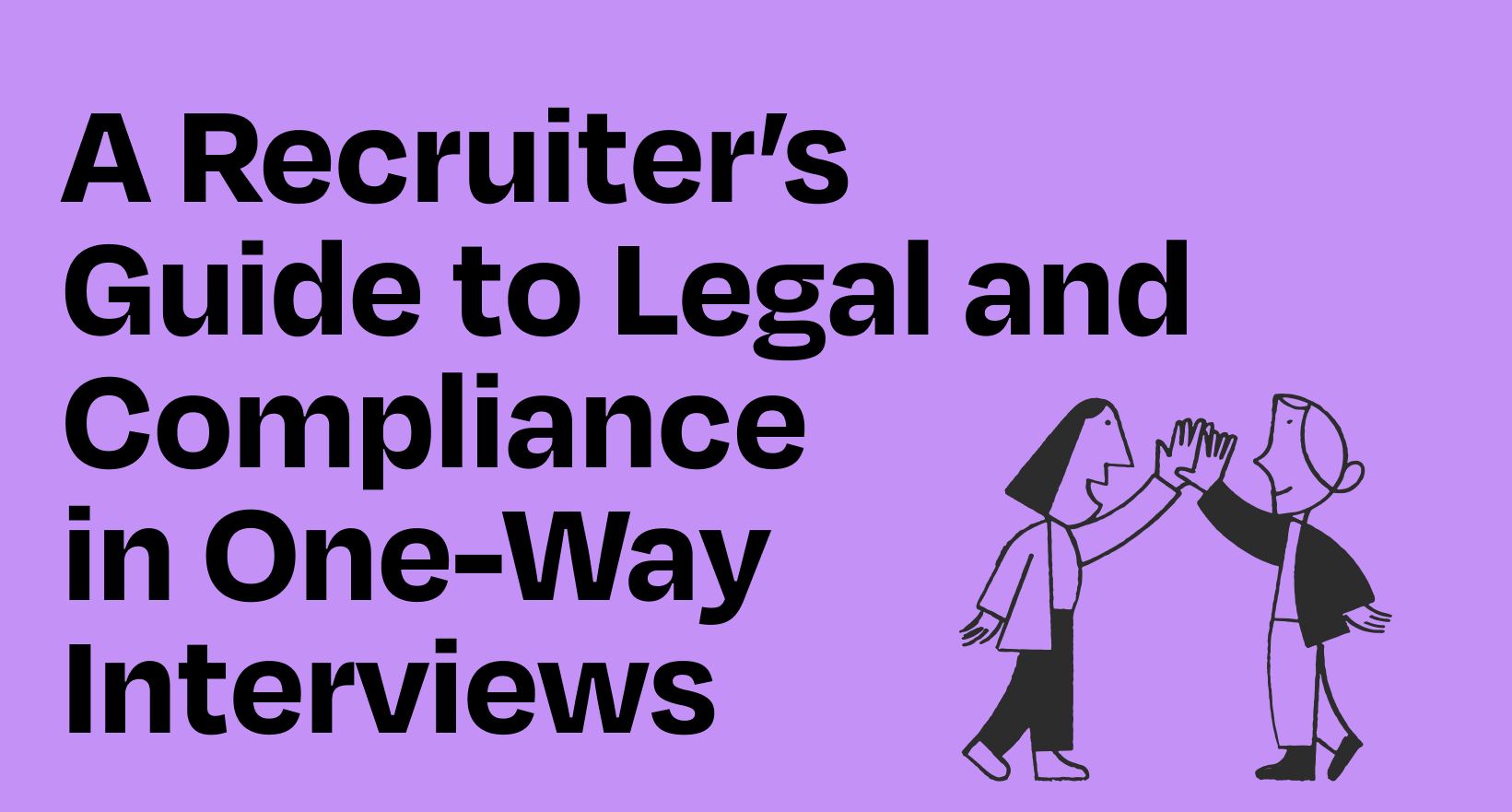
A Recruiter’s Guide to Legal and Compliance in One-Way Interviews

When used correctly, one-way interviews deliver speed without sacrificing fairness. So both your hiring funnel and procurement process keep moving!
Written by
Dominic Mancini
Published
February 9, 2026
AI Recruiting
Share post
Want to learn more?
Subscribe for you recruiting tips, employer branding suggestions to really help your ora stand out!
Thank you! Your submission has been received!
Oops! Something went wrong while submitting the form.

Table of Contents

  • How are AI Tools Used in Recruitment? 
  • Your Legal Team Can Help Ensure Compliance 
  • One-Way Interview Tools Worth Exploring 
  • Frequently Asked Questions

From data privacy to bias reduction, today’s recruiters must balance compliance with tech-driven efficiency. This guide breaks down one-way interview elements like audio, video, and AI — and how recruiters can streamline operations without sacrificing fairness or causing approval bottlenecks in procurement!

How are AI Tools Used in Recruitment? 

In the world of recruitment, AI tools can power everything from sourcing and screening to interviews and scheduling.

Emerging technology is most remarkable at peak moments in hiring, especially the top of your talent funnel. When applications pour in, recruiters need speed without sacrificing quality, and that’s where automation shines.

Think of an AI tool as your savvy assistant that never gets tired, even after screening hundreds of resumes. While AI handles the repetitive tasks, you’re given time for what really matters: genuine conversations with qualified candidates.

Saving time at top of the funnel 

This is where the one-way interview earns its keep, especially for high-volume roles. Forget scheduling hundreds of intro calls. Instead, with one-way interviews, candidates can record responses on their own time, and recruiters review when it’s convenient for them.

In general, it’s an on-demand interviewing system that replaces calendar chaos with instant access to candidate stories.

Add AI into the mix and things get even smoother. An AI interviewer like Puck can summarize responses, highlight patterns, and surface promising applicants in minutes so that recruiters can spend time with the highest quality candidates.

Add AI into the mix and your workload just became even more efficient.

An AI interviewer like Puck helps expedite your process by engaging in a back-and-forth with candidates, revealing additional information about the top of your funnel, and giving hiring teams more time to focus on meaningful conversations.

This is a game changer for teams running high-volume recruiting software. Automation incorporated properly keeps the funnel moving without burning out your humans (or their coffee machines).

Your Legal Team Can Help Ensure Compliance

Great hiring tech isn’t just fast — it’s also fair, reliable, and compliant. That’s why recruiters should loop in their legal partners early, making sure new one-way interview tools get a green light before they go live.

Below are a few key areas your legal team can help you review together, so that you can confidently roll out one-way interview tools that meet equity, privacy, and candidate-experience standards.

Audio vs. video

Audio and video interviews both offer more context than a one-page resume. But they play very differently in the compliance sandbox.

Video-based one-way interviews add visual elements that can unintentionally introduce bias, from appearance and background to camera quality. They also require more setup with lighting and microphones.

But audio-first tools remove those visual signals. After all, it’s an interview, not a photo shoot! Audio platforms make it easier to focus on what candidates say, not their mannerisms or backdrop.

Audio also lowers the barrier to entry. Candidates can record from their phones, during a lunch break, or between shifts — no studio setup required. And fewer hurdles = more completed interviews = a shorter timeline from screening to offer letter.

Importantly, from a policy standpoint, audio interviews are easier to standardize, store, and scan. It’s a simpler path to compliance but with the same meaningful insight.

AI vs. non-AI

Interview tools that lack AI typically give every candidate the same set of questions in the same format. Sounds like convenience, right? But that consistency can lead to stiff, boilerplate answers and fewer chances for candidates to show what actually makes them unique.

AI-powered tools do a better job of customizing the interview. However, some AI tools take things a step too far by analyzing the candidates themselves — which raises ethical and compliance red flags.

Compliance is a breeze when AI focuses on the conversation, using what candidates say to tailor tone and phrasing, and to field questions in real time. That creates a more natural environment, strengthens employer branding, and gives recruiters richer material to evaluate.

The right AI tools don’t ask questions that recruiters haven’t approved. Because when AI-generated questions step out of bounds from a recruiter’s approval, a recruiter cannot properly evaluate and review the responses.

And without a recruiter’s review, there’s no human oversight, which introduces both ethical and compliance risks. 

The safest, smartest interview systems ensure every question stays within a framework that recruiters and legal teams can stand behind.

An AI one-way interviewer like Puck doesn’t just collect answers; it helps guide the conversation without making candidate recommendations. The analysis and strategic decisions are left for talent teams, and legal can follow the full trail from data to human-led recommendations — no mystery boxes required.

When AI asks questions that humans are prepared to review, technology and oversight work hand in hand from interview to offer.

Tech for screening, not hiring decisions

Technology should speed up screening while keeping your recruitment process clear and manageable.

AI can speak, sort, summarize, but human recruiters should stay in charge. And when technology is designed to support their judgment, the entire process moves like a breeze.

One-Way Interview Tools Worth Exploring

Puck

In a nutshell: Audio-first AI interviewer built for compliance 

Puck is an agile AI-powered interviewer built for compliance and fast screening at the top of your funnel.

We use audio-first one-way interviews to make your hiring process more efficient. Technology works behind the scenes while human recruiters make the final call on who gets hired.

The AI interviewer asks smart, real-time, job-specific questions, then summarizes responses so hiring teams can focus on the relevant takeaways.

Because analysis and decisions always stay with humans, teams get speed without surrendering control. And since Puck is audio-first, it naturally reduces bias and lowers barriers for candidates = a win for fairness and fastness in your flow.

Interviewer.AI

In a nutshell: AI-powered video platform for one-way interviews

It’s a video interview tool that lets candidates record responses asynchronously while using AI to screen at scale.

Recruiters create questions, invite candidates at mass, and let the platform handle the rest — like a virtual host that never loses its place in the script.

Interviewer.AI offers scoring and structuring to help teams sort through responses quickly but without trading speed for substance. It’s a good fit for teams that want video context plus the power of emerging technology.

Interviewstream

In a nutshell: Audio-first screening with on-demand flexibility 

Interviewstream lets teams run one-way interviews using audio prompts (plus other response formats), so candidates can respond quickly without turning their living room into a film set.

It’s built for asynchronous review: recruiters send questions once, then listen and evaluate on their own schedule.

Because it doesn’t rely on an AI layer to summarize or recommend candidates, the review process is more manual—meaning it won’t accelerate the top of the funnel as much as an AI-driven system.

Still, Interviewstream’s audio-first screening lowers barriers (phone-friendly and faster completion), which reduces delays and keeps your timeline moving in the right direction.

VidCruiter

In a nutshell: Enterprise-level video interview platform

VidCruiter is a robust video interview and recruitment platform used by mid-sized to large organizations that hold structure and scale.

It supports both live and asynchronous video interviews, with customizable workflows and detailed scorecards for high-volume hiring environments.

The platform’s enterprise credentials — deep functionality, skills testing, and accessibility features — make it suitable for teams where governance and documentation matter.

Because it’s more heavyweight than audio-first options, VidCruiter is a match for teams with dedicated recruiting ops who are ready to manage a full feature set. 

Frequently Asked Questions

What type of recruiting software works best for small businesses?

Small teams benefit from lightweight tools that automate the top of the funnel with minimal complexity.

Bells and whistles are nice, but small companies often have a solo recruiter wearing many hats. Simple one-way interview platforms let candidates respond on their own time and recruiters review when ready.

Look for an on-demand interviewing system that doesn’t require a full IT team. Easy tools mean quick hires and fewer headaches.

What is the best kind of platform for virtual interviews?

Your ideal platform balances flexibility with fairness. Audio and video options both work, but audio-first tools lower barriers and reduce bias.

An AI-powered interviewer like Puck can help summarize and organize responses so nothing slips through the cracks.

The result is virtual interviews that feel human, not hectic.

When is video format useful for interviews?

Video-first platforms pair well when presence and presentation matter. They let candidates record responses while showing visual context early on.

Just remember that introducing a camera means extra compliance and bias considerations. Video is powerful, and it needs thoughtful policies to match.

How can you find the right conversational AI recruitment software?

Prioritize transparency and human oversight.

The best tools use AI to assist, not as a deciding vote. An AI interviewer should ask relevant questions, pivot in real time during the conversation, and provide clear summaries for recruiters to review.

When tech supports human expertise instead of replacing it, it’s a win for applicants and recruiters. 

What are some alternatives to Hirevue?

Hirevue is a popular video-focused option for large enterprises. Alternatives include audio-first platforms, AI-driven one-way interview tools, and lightweight recruiting software built for speed and fairness. Notably, Hirevue does not use automation for conversational AI recruiting, but uses it for analysis after an interview.

The right Hirevue alternative depends on your team size, level of compliance support, and how much automation you want. Pick a tool that adjusts to you and your workflow, not the other way around.

See what Puck can do for you

Explore how Puck has helped companies in Tech, Retail, and Healthcare hire better and faster

A Recruiter’s Guide to Legal and Compliance in One-Way Interviews

February 6, 2026

When used correctly, one-way interviews deliver speed without sacrificing fairness. So both your hiring funnel and procurement process keep moving!

Dominic Mancini

Table of Contents

  • How are AI Tools Used in Recruitment? 
  • Your Legal Team Can Help Ensure Compliance 
  • One-Way Interview Tools Worth Exploring 
  • Frequently Asked Questions

From data privacy to bias reduction, today’s recruiters must balance compliance with tech-driven efficiency. This guide breaks down one-way interview elements like audio, video, and AI — and how recruiters can streamline operations without sacrificing fairness or causing approval bottlenecks in procurement!

How are AI Tools Used in Recruitment? 

In the world of recruitment, AI tools can power everything from sourcing and screening to interviews and scheduling.

Emerging technology is most remarkable at peak moments in hiring, especially the top of your talent funnel. When applications pour in, recruiters need speed without sacrificing quality, and that’s where automation shines.

Think of an AI tool as your savvy assistant that never gets tired, even after screening hundreds of resumes. While AI handles the repetitive tasks, you’re given time for what really matters: genuine conversations with qualified candidates.

Saving time at top of the funnel 

This is where the one-way interview earns its keep, especially for high-volume roles. Forget scheduling hundreds of intro calls. Instead, with one-way interviews, candidates can record responses on their own time, and recruiters review when it’s convenient for them.

In general, it’s an on-demand interviewing system that replaces calendar chaos with instant access to candidate stories.

Add AI into the mix and things get even smoother. An AI interviewer like Puck can summarize responses, highlight patterns, and surface promising applicants in minutes so that recruiters can spend time with the highest quality candidates.

Add AI into the mix and your workload just became even more efficient.

An AI interviewer like Puck helps expedite your process by engaging in a back-and-forth with candidates, revealing additional information about the top of your funnel, and giving hiring teams more time to focus on meaningful conversations.

This is a game changer for teams running high-volume recruiting software. Automation incorporated properly keeps the funnel moving without burning out your humans (or their coffee machines).

Your Legal Team Can Help Ensure Compliance

Great hiring tech isn’t just fast — it’s also fair, reliable, and compliant. That’s why recruiters should loop in their legal partners early, making sure new one-way interview tools get a green light before they go live.

Below are a few key areas your legal team can help you review together, so that you can confidently roll out one-way interview tools that meet equity, privacy, and candidate-experience standards.

Audio vs. video

Audio and video interviews both offer more context than a one-page resume. But they play very differently in the compliance sandbox.

Video-based one-way interviews add visual elements that can unintentionally introduce bias, from appearance and background to camera quality. They also require more setup with lighting and microphones.

But audio-first tools remove those visual signals. After all, it’s an interview, not a photo shoot! Audio platforms make it easier to focus on what candidates say, not their mannerisms or backdrop.

Audio also lowers the barrier to entry. Candidates can record from their phones, during a lunch break, or between shifts — no studio setup required. And fewer hurdles = more completed interviews = a shorter timeline from screening to offer letter.

Importantly, from a policy standpoint, audio interviews are easier to standardize, store, and scan. It’s a simpler path to compliance but with the same meaningful insight.

AI vs. non-AI

Interview tools that lack AI typically give every candidate the same set of questions in the same format. Sounds like convenience, right? But that consistency can lead to stiff, boilerplate answers and fewer chances for candidates to show what actually makes them unique.

AI-powered tools do a better job of customizing the interview. However, some AI tools take things a step too far by analyzing the candidates themselves — which raises ethical and compliance red flags.

Compliance is a breeze when AI focuses on the conversation, using what candidates say to tailor tone and phrasing, and to field questions in real time. That creates a more natural environment, strengthens employer branding, and gives recruiters richer material to evaluate.

The right AI tools don’t ask questions that recruiters haven’t approved. Because when AI-generated questions step out of bounds from a recruiter’s approval, a recruiter cannot properly evaluate and review the responses.

And without a recruiter’s review, there’s no human oversight, which introduces both ethical and compliance risks. 

The safest, smartest interview systems ensure every question stays within a framework that recruiters and legal teams can stand behind.

An AI one-way interviewer like Puck doesn’t just collect answers; it helps guide the conversation without making candidate recommendations. The analysis and strategic decisions are left for talent teams, and legal can follow the full trail from data to human-led recommendations — no mystery boxes required.

When AI asks questions that humans are prepared to review, technology and oversight work hand in hand from interview to offer.

Tech for screening, not hiring decisions

Technology should speed up screening while keeping your recruitment process clear and manageable.

AI can speak, sort, summarize, but human recruiters should stay in charge. And when technology is designed to support their judgment, the entire process moves like a breeze.

One-Way Interview Tools Worth Exploring

Puck

In a nutshell: Audio-first AI interviewer built for compliance 

Puck is an agile AI-powered interviewer built for compliance and fast screening at the top of your funnel.

We use audio-first one-way interviews to make your hiring process more efficient. Technology works behind the scenes while human recruiters make the final call on who gets hired.

The AI interviewer asks smart, real-time, job-specific questions, then summarizes responses so hiring teams can focus on the relevant takeaways.

Because analysis and decisions always stay with humans, teams get speed without surrendering control. And since Puck is audio-first, it naturally reduces bias and lowers barriers for candidates = a win for fairness and fastness in your flow.

Interviewer.AI

In a nutshell: AI-powered video platform for one-way interviews

It’s a video interview tool that lets candidates record responses asynchronously while using AI to screen at scale.

Recruiters create questions, invite candidates at mass, and let the platform handle the rest — like a virtual host that never loses its place in the script.

Interviewer.AI offers scoring and structuring to help teams sort through responses quickly but without trading speed for substance. It’s a good fit for teams that want video context plus the power of emerging technology.

Interviewstream

In a nutshell: Audio-first screening with on-demand flexibility 

Interviewstream lets teams run one-way interviews using audio prompts (plus other response formats), so candidates can respond quickly without turning their living room into a film set.

It’s built for asynchronous review: recruiters send questions once, then listen and evaluate on their own schedule.

Because it doesn’t rely on an AI layer to summarize or recommend candidates, the review process is more manual—meaning it won’t accelerate the top of the funnel as much as an AI-driven system.

Still, Interviewstream’s audio-first screening lowers barriers (phone-friendly and faster completion), which reduces delays and keeps your timeline moving in the right direction.

VidCruiter

In a nutshell: Enterprise-level video interview platform

VidCruiter is a robust video interview and recruitment platform used by mid-sized to large organizations that hold structure and scale.

It supports both live and asynchronous video interviews, with customizable workflows and detailed scorecards for high-volume hiring environments.

The platform’s enterprise credentials — deep functionality, skills testing, and accessibility features — make it suitable for teams where governance and documentation matter.

Because it’s more heavyweight than audio-first options, VidCruiter is a match for teams with dedicated recruiting ops who are ready to manage a full feature set. 

Frequently Asked Questions

What type of recruiting software works best for small businesses?

Small teams benefit from lightweight tools that automate the top of the funnel with minimal complexity.

Bells and whistles are nice, but small companies often have a solo recruiter wearing many hats. Simple one-way interview platforms let candidates respond on their own time and recruiters review when ready.

Look for an on-demand interviewing system that doesn’t require a full IT team. Easy tools mean quick hires and fewer headaches.

What is the best kind of platform for virtual interviews?

Your ideal platform balances flexibility with fairness. Audio and video options both work, but audio-first tools lower barriers and reduce bias.

An AI-powered interviewer like Puck can help summarize and organize responses so nothing slips through the cracks.

The result is virtual interviews that feel human, not hectic.

When is video format useful for interviews?

Video-first platforms pair well when presence and presentation matter. They let candidates record responses while showing visual context early on.

Just remember that introducing a camera means extra compliance and bias considerations. Video is powerful, and it needs thoughtful policies to match.

How can you find the right conversational AI recruitment software?

Prioritize transparency and human oversight.

The best tools use AI to assist, not as a deciding vote. An AI interviewer should ask relevant questions, pivot in real time during the conversation, and provide clear summaries for recruiters to review.

When tech supports human expertise instead of replacing it, it’s a win for applicants and recruiters. 

What are some alternatives to Hirevue?

Hirevue is a popular video-focused option for large enterprises. Alternatives include audio-first platforms, AI-driven one-way interview tools, and lightweight recruiting software built for speed and fairness. Notably, Hirevue does not use automation for conversational AI recruiting, but uses it for analysis after an interview.

The right Hirevue alternative depends on your team size, level of compliance support, and how much automation you want. Pick a tool that adjusts to you and your workflow, not the other way around.

Hear from our customers